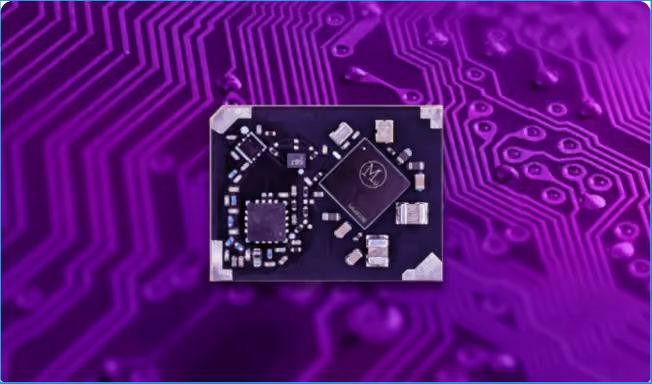
Sydney, Australia – 1 June, 2026 – Morse Micro, the world's leading Wi-Fi HaLow silicon provider, today announced the MM8108-M20, a high-power Wi-Fi HaLow module designed to help product teams in the US and Canada bring long-range, low-power Wi-Fi HaLow devices to market faster.
Built around Morse Micro's second-generation MM8108 Wi-Fi HaLow System on a Chip (SoC), the MM8108-M20 brings sub-GHz Wi-Fi connectivity into a compact, fully integrated module measuring 18.5 mm x 14 mm. Designed for the 902-928 MHz band, the module supports 1, 2, 4 and 8 MHz channel bandwidths, giving product developers the flexibility to optimize range, throughput and power consumption across a range of applications.
The MM8108-M20 combines Morse Micro's Wi-Fi HaLow silicon with an external high-power amplifier delivering up to 28.5 dBm transmit output power, alongside a surface acoustic wave (SAW) filter tuned for the 902-928 MHz band of the North American markets. Together, these enhancements are designed to deliver strong long-range performance, excellent receive sensitivity and a faster path to integration for product teams building connected devices for environments where conventional Wi-Fi falls short.
"The MM8108-M20 is more than a new module – it's another accelerator for the Wi-Fi HaLow ecosystem," said Michael De Nil, co-founder and CEO of Morse Micro. "By making our second-generation silicon available in a high-power, integration-ready form factor, we're helping module partners, OEMs and other embedded product teams move faster, reduce development complexity and bring long-range IoT products to market with greater confidence."
The MM8108-M20 is an important step in Morse Micro's strategy to make Wi-Fi HaLow easier to adopt at scale. While the MM8108 SoC provides the silicon foundation for next-generation IoT connectivity, the MM8108-M20 turns that performance into a compact, production-ready module platform for OEMs, ODMs, design houses and embedded developers.
FCC/IC Certified, the MM8108-M20 is ideally suited to applications like surveillance cameras and access points. It supports a single-stream maximum PHY rate of 43.3 Mbps at 8 MHz bandwidth and includes flexible host interfaces, with support for USB 2.0 High-Speed, SDIO 2.0 and SPI. For product teams, this makes it easier to integrate Wi-Fi HaLow into embedded platforms and architectures.
Availability
The MM8108-M20-US is already available for sampling to Morse Micro's certified module partners. For more information, contact sales@morsemicro.com.
About Morse Micro
Morse Micro is the leading Wi-Fi HaLow fabless semiconductor company, revolutionizing IoT connectivity with award-winning technology. Headquartered in Sydney, with global offices in the United States, Taiwan, China, India, Japan and the United Kingdom, Morse Micro is driving the adoption of next-generation long-range, low-power Wi-Fi HaLow solutions. Its first-generation MM6108 and newly launched MM8108 silicon deliver the fastest, smallest, lowest-power, and longest-range Wi-Fi HaLow connectivity on the market.
Morse Micro's Wi-Fi HaLow technology is gaining unstoppable momentum globally, enabling connected devices to achieve ten times the range, covering 100 times the area of traditional Wi-Fi networks. This advancement is transforming IoT connectivity across various sectors, including smart homes, industrial automation, and smart cities.